

Multiplication is one of the very first and most important mathematical skills children need to learn at school. It is the foundation of maths learning, helping children to gain confidence and tackle more complicated maths tasks at greater speed.
As with so many parts of education, different children learn at different speeds and in different ways. Whether a child is behind their classmates on their times tables or is speeding ahead, here are some of our favourite techniques from our private school in Devon, with various approaches to suit diverse minds.
Hang a Multiplication Table
While there is numerical logic to multiplication, times tables are essentially a memory test. Multiplication tables aim to help children (and adults) multiply numbers without having to think about it, freeing up brain space to work out more complex parts of a problem.
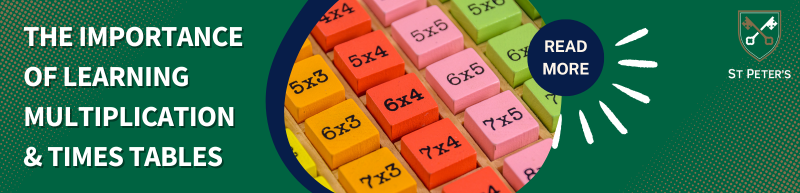
One great way to make sure you remember something is to write it down and pin it up, which is why having a physical multiplication table can really help. Tables can be purchased online or in most stationery, craft, and book stores, in various sizes and colours. Being able to see the table every day encourages children to look and learn patterns, which can support regular memorisation practice.
Try Skip Counting
Skip counting is something young children practice early in their journey with numbers, and is a fantastic way of developing early maths skills.
Skip counting is simply counting by a certain number each time, skipping the numbers in between. For example, skip counting in twos would go like this: 2, 4, 6, 8, 10.
As you can see, skip counting is essentially the same as learning your multiplication tables! Instead of memorising individual sums, skip counting can be used to understand patterns of multiples: 2×2=4, 2×3=6, and so on.
A similar technique to skip counting is repeated addition, which breaks multiplication down into addition. For example, 2×6=12 can also be 2+2+2+2+2+2=12. This can be a helpful backup when forgetting a number in the multiplication tables, and also gives children the skills to check their answers.
Use Words & Images to See Multiplication in the Real World
For children who are more visual learners, it can be really useful to introduce multiplication sums as part of everyday life.
Use phrases to explain what multiplication means. For example, 7×8 is also seven groups of eight, or seven lots of eight. Imagery takes it one step further – 7×8 could be seven candles on eight birthday cakes, or seven people on eight buses.
Some children will find multiplication much easier when it’s laid out in these everyday ways. You can visualise the sum using your child’s favourite toys, or even let them draw it out as items on a piece of paper. The more children enjoy this method, the quicker and easier they’ll find it to create the visualisation in their head when presented with new sums.
Enjoy the Simple Rules
A great way to get children enthused about times tables is to work on the simplest aspects first. If they can understand and succeed with the easiest numbers, they’ll be more confident facing the harder challenges.
These are three of multiplication’s simplest rules:
- Everything multiplied by one stays the same number (e.g. 7×1=7)
- Everything multiplied by zero becomes zero (e.g. 11×0=0)
- The opposite sum always has the same answer (e.g. 5×6=30 and 6×5=30)
Learning these rules allows children to memorise large parts of the times tables quickly, building confidence.
Look for Tricks to Tricky Numbers
The multiplication table is all about patterns, although some are easier than others. Counting in twos is straightforward, but seeing the pattern in nines is less easy.
Thankfully, there are some tricks children can use to learn some of the harder parts of the multiplication table. Here are some of our favourites:
- 2s double the number (9×2=18), 4s double then double again (9×4=36), while 8s double three times (9×8=72).
- For 5s, cut the number in half, then times by 10 (5×4=10×2=20).
- For 9s, as the ten digit goes up, the ones digit goes down (9, 18, 27, 36…).
- For 12s, split into 10s and 2s then add together (12×11=(10×11)+(2×11)=132).
Play Multiplication Games
Making learning fun is always important when trying to teach young children, and there are many maths-based games out there designed to help children with their multiplication.
Nowadays, there are various online games and apps designed to help children with their multiplication tables in a fun way. If you don’t want to give young children another reason to be on their screens, however, there are also plenty of physical games available.
If you want a multiplication game for home, try a popular card game called Multiplication War. All you do is split a deck of cards, and each turn, players turn over two cards. The card numbers are multiplied (agree on the numbers for face cards beforehand), and whoever has the biggest number wins those cards. This is a fun way to get children practising multiplication sums.
Repeat, Repeat, Repeat!
As mentioned at the start, multiplication tables are ultimately memory games. While understanding how multiplication works is important, children want to get to a stage where they can find the answers in their head almost instantly, which is where memorisation comes into play.
The key to memory is repetition, so whichever of the above tips or techniques works best for them, make sure they’re continuing to practice both easy and difficult numbers. If they can practice regularly, it won’t be too long before they’re a multiplication whizz!